
Blog: Why Certified Seed Remains One of the Smartest Investments for UK Growers
From establishment to sustainability, the Agricultural Industries Confederation's (AIC) Head of Combinable Crops and Seed Rose Riby takes a look at why certified cereal seed remains a smart choice for UK growers.
At a Glance
For Agricultural Industries Confederation (AIC) Members and UK growers, certified seed is a practical way to build confidence and consistency during establishment, backed by transparent, independently verified standards.
-
Independent certification provides clear standards, full traceability, and confidence in what you are buying, while supporting future UK plant breeding progress.
-
European Seed Treatment Assurance (ESTA)-backed oversight ensures seed treatments are applied professionally and evenly, with audited checks on coverage and dose.
-
More consistent varietal performance (true‑to‑type seed).
-
Lower risk of seed‑borne disease issues early in the season.
-
More reliable yield and crop quality potential, reducing the risk of downgrades through better uniformity and specification compliance.
-
Sustainability benefits: more even establishment and more efficient use of nutrients, water and light, with fewer avoidable failures and fewer “rescue” sprays.
Every season brings a new set of challenges for UK arable farmers. Margins are tight. Weather patterns are increasingly unpredictable. Disease profiles are shifting. Chemistry options continue to narrow, and markets demand tighter quality specifications. In this environment, the decisions made before a seed ever goes into the ground have a greater impact than ever on crop performance and overall profitability.
Among those decisions, seed choice stands out. Certified seed continues to offer agronomic, economic, and regulatory advantages that make it a sound investment for modern UK farming.
Start Strong with Certified Seed: Reliability from Day One
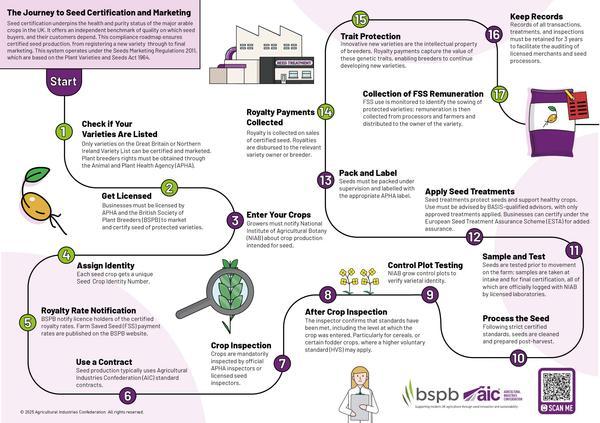
Seed is the foundation of every crop. Certified seed is produced under strict UK regulations and independently tested to verify varietal identity, physical purity, germination, and quality.
This gives growers confidence that what is printed on the label is exactly what is being drilled, with no surprises, no unexpected mixtures, and lower contamination risk.
Certified seed also provides access to the most modern and effective seed treatment options. These are applied professionally to ensure every seed receives the correct dose of product.
Application processes are independently checked and audited regularly through assurance schemes such as the European Seed Treatment Assurance (ESTA) scheme.
This attention to quality translates directly into stronger field performance and improved crop establishment.
Certified seed is laboratory tested for both germination and vigour, helping to deliver faster and more uniform emergence.
This results in even, competitive crop stands, stronger suppression of weeds and greater resilience during challenging autumn or spring conditions.
For growers, it simply means one less variable to worry about at the start of the season.
Protect Yield Potential with Proven Genetics
Research shows that certified seed delivers higher and more stable yields by maintaining the full genetic potential of modern varieties.
Certified seed ensures that key traits, such as disease resistance, standing power and quality parameters, perform as breeders intended.
By contrast, repeatedly using farm‑saved seed (FSS) year after year can introduce subtle but cumulative issues: genetic drift, increased off‑types and a steady decline in overall performance. These changes are not always obvious until performance starts to slip.
Certified seed ensures growers benefit from the variety’s full genetic potential, exactly as breeders intended.
Built‑In Protection Against Seed‑Borne Disease
Seed-borne diseases can compromise crop performance long before symptoms appear.
Certified seed is rigorously inspected and tested to minimise the presence of seed‑borne pathogens.
This reduces early infection pressure and supporting integrated pest management (IPM) strategies.
With fewer chemical options available and resistance continuing to rise, this built-in protection is becoming increasingly valuable.
It reduces the risk of starting the season at a disadvantage.
Is Certified Seed Worth the Cost?
From an economic standpoint, even modest yield improvements can more than offset the initial cost of certified seed.
Key benefits include:
-
Enhanced and more reliable establishment
-
Higher and more stable yields
-
Fewer issues affecting crop uniformity
-
Reduced risk of quality rejections or downgrades
For growers supplying markets where quality matters, such as milling, malting, oilseed for crushing, or premium feed markets, reliability, consistency, and specification compliance can be as valuable as outright yield.
In a cropping system influenced by so many factors outside a grower’s control, certified seed offers a rare opportunity to lock in confidence from the outset.
Investing in the Future of UK Plant Breeding
Choosing certified seed also supports the wider agricultural sector. Revenue from certified sales helps fund the UK’s plant breeding programmes, driving the development of new varieties with improved yields, stronger climate resilience and enhanced disease resistance.
A sustainable and well‑supported seed sector is essential for continued progress.
By choosing certified seed, growers directly contribute to future genetic progress for British agriculture.
Why Certified Seed Supports Sustainable Farming
Certified seed might sound like a technical detail, but it is one of the simplest ways to make farming more sustainable.
Because it is tested for germination, purity and varietal consistency, it supports more even establishment and more efficient use of nutrients, water and light.
The result: more output per hectare with less waste and a lower emissions footprint.
It also helps cut avoidable problems. Certified lots are specifically checked for noxious weeds and key seed‑borne diseases, lowering the risk of early crop failures and reducing the need for later “rescue” sprays.
On top of that, modern varieties bring additional built‑in traits like stronger disease resistance, improved drought tolerance, and better nitrogen‑use efficiency, which matter more as weather becomes more unpredictable.
Economically, certified seed reduces hidden risks associated with farm‑saved seed and helps deliver more predictable performance.
At a wider system-level, certification supports transparency, traceability and confidence throughout the supply chain, while rewarding the breeding innovation that drives long‑term progress.
A Simple, Reliable Step Towards Lower Risk and Higher Resilience
In an era shaped by uncertainty, unpredictable weather, tightening margins, changing regulations, and shifting pest and disease pressures, certified seed remains one of the simplest and most reliable ways to safeguard crop performance, profitability, and long‑term farm resilience.
For growers looking to build strength and security into their cropping strategy, it is a decision that continues to deliver.
A Simple Decision with Long‑Term Benefits
In a farming environment shaped by uncertainty, few decisions offer such a clear combination of confidence, consistency and long‑term value.
Certified seed gives growers a strong, reliable starting point, protecting yield potential, supporting sustainability goals and reducing avoidable risk from the outset.
As pressures on margins, inputs and regulation continue to evolve, certified seed remains one of the simplest and most effective investments UK growers can make, delivering benefits not just for the coming season, but for the future of the crop, the farm business and the wider industry.
Frequently Asked Questions (FAQs) About Certified Seed
For Agricultural Industries Confederation (AIC) Members and UK growers, certified seed is a practical way to build confidence and consistency during establishment, backed by transparent, independently verified standards.
What is certified cereal seed?
Certified seed is seed that has been independently verified against clear standards for varietal identity, purity, germination and quality. For UK growers, it provides confidence that what is on the label is what is being drilled, supporting consistency and reliability during crop establishment.
How does certification improve transparency and traceability?
Independent certification provides full traceability through the supply chain and clear, auditable standards. This transparency gives growers confidence in what they are buying, while also supporting continued investment in UK plant breeding and varietal development.
How are seed treatments applied and checked?
Where seed is treated, oversight schemes such as the European Seed Treatment Assurance (ESTA) scheme help ensure treatments are applied professionally and evenly. Application processes are audited, including checks on coverage and dose, to support consistent performance and responsible use.
What are the agronomic benefits of certified seed?
Certified seed supports more consistent, true‑to‑type varietal performance and reduces the risk of seed‑borne disease issues early in the season. Laboratory testing for germination and vigour helps deliver more uniform establishment, improving yield and crop quality potential and reducing the risk of downgrades linked to uneven crops.
Does certified seed support sustainable farming?
Yes. More even establishment allows crops to make more efficient use of nutrients, water and light, reducing avoidable failures and the need for later “rescue” sprays. These efficiency gains support both economic and environmental sustainability at farm level.Author

Rose Riby
Rose Riby is Head of Combinable Crops and Seed. Having worked across these sectors for many years, she has a depth and breadth of experience in roles in grain trading, plant breeding and knowledge exchange at AHDB.