
Blog: EU–UK SPS Agreement - Early 2026 Update and Sector Impacts
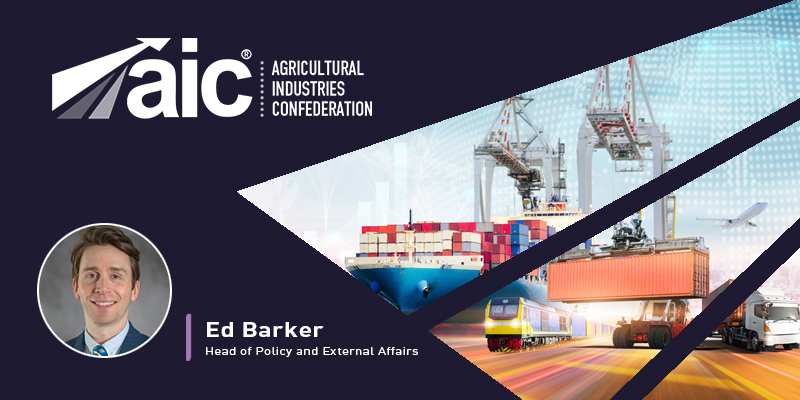
As EU–UK Sanitary and Phytosanitary (SPS) negotiations move from preparatory work into formal talks, with a proposed “Common SPS Area” and dynamic alignment now on the table, Head of Policy and External Affairs Ed Barker outlines what’s changing, what it means for AIC sectors, and what happens next.
It has been well publicised that the European Union (EU) and the United Kingdom (UK), as part of their ‘reset’, intend to implement a Sanitary and Phytosanitary (SPS) agreement with one another. This follows five years of divergence on regulatory standards and the trade barriers that have arisen as a result.
Here are the main points.
1. Things are now moving forwards, and quickly
The key shift since last year is that talks have moved from preparatory work into formal negotiations. Both sides confirmed that the first SPS negotiating round took place in December 2025, following EU Member State approval of the European Commission’s negotiating mandate in November.
A joint EU–UK press statement on 17 December 2025 signalled a shared ambition to conclude negotiations ahead of the next EU–UK summit, which the UK is aiming to hold in the coming months.
Within the Department for Environment, Food and Rural Affairs (Defra), two teams are set to deliver this significant piece of work:
-
an EU SPS negotiations team focused on the terms and scope of the SPS agreement
-
an EU delivery team responsible for working with trade bodies such as the Agricultural Industries Confederation (AIC) to ensure businesses understand the changes and necessary supply‑chain adaptations
This work also includes bringing together regulatory bodies such as the Food Standards Agency (FSA) and the Animal and Plant Health Agency (APHA), which hold statutory functions across the UK.
-
May 2025: EU-UK Reset Summit held, SPS agreement supportive by both parties
-
Nov 2025: Commission mandate approved
-
Dec 2025: First SPS negotiating round
-
Early 2026: Negotiations continue and Sector engagement intensifies
-
Jan 2027: Aspirational completion target of the legislation by UK Government
-
2027: Possibility of transitional arrangements (it remains unclear, and over what period, transitional arrangements may take effect)
2. Negotiations are based around a “Common SPS Area” with dynamic alignment
Since December, multiple official sources have clarified the substance of the talks. Negotiations are centred on establishing a UK–EU Common Sanitary and Phytosanitary Area, under which Great Britain would dynamically align by adopting with EU SPS rules on:
-
food safety
-
animal health
-
plant health
-
organics
-
pesticides
-
marketing standards
Dynamic alignment would allow most agri‑food movements between Great Britain and the EU to occur without export health certificates, phytosanitary certificates or routine border checks.
In return, the UK would make a financial contribution and gain non‑voting access to certain EU committees, databases, and information‑sharing systems such as Rapid Alert System for Food and Feed (RASFF). Where relevant, EU law would ultimately be interpreted by the Court of Justice of the European Union (CJEU).
3. Where this leaves AIC Sectors
As anticipated in late 2025, Defra has been engaging with specific AIC sectors. Discussions are now moving from broad considerations to sector‑specific detail, with AIC policy teams and Members in regular conversations with the relevant Defra officials on the practical implications of EU alignment.
Examples include:
-
the transition required in pesticides policy, particularly following the recent CropLife‑commissioned report outlining the need for a sensible transition period and the impacts of losing four key active substances approved for use in GB since EU Exit. It also assesses the loss of 14 other active substances approved for use in GB which the EU has withdrawn.
-
meetings with seed teams, on future certification and testing, common catalogues
-
working with Cabinet Office, FSA on animal feed considerations, including feed additive approvals, animal by-products and fish feed market access,
-
working with Defra and other industry stakeholders on Maximum Residue Limits (MRLs) and contaminant alignment for grains and feeds.
AIC committees have also been actively engaged throughout this process. Meanwhile, AIC’s European Associations, the European Compound Feed Manufacturers’ Federation (FEFAC), the European association of trade in cereals, oilseeds, rice, pulses, olive oil, oils and fats, animal feed and agrosupply (COCERAL) and Euroseeds have all been consulted on this work, with the latter two establishing specific EU-UK SPS working groups.
4. Can we expect exemptions?
In their initial agreement, the European Commission and the UK acknowledged that targeted exemptions to SPS alignment may be possible. However, to be granted, these exemptions would need to meet strict conditions:
-
To not lower standards compared with EU rules,
-
To not disadvantage EU animals or goods,
-
To ensure that only EU‑compliant goods can enter the EU market.
These conditions mean that exemptions would not necessarily alleviate practical challenges, as careful consideration would be required to determine how these tests could be met and evidenced to the Commission. The Government has however been open in that it is seeking some limited exemptions, through these are still being negotiated.
5. And what about precision breeding?
A key area of discussion is the UK’s Precision Breeding Act, in force in England, and whether it can be retained within an aligned SPS framework. This is particularly pressing given the significant effort required to secure the legislation and the fact that applications are now being submitted to the FSA under the new regime.
It is also relevant that the EU has advanced its own approach to precision breeding through its New Genomic Techniques (NGTs) proposal, which passed a major vote in December 2025. With both the EU and England now progressing in this area, policy remains dynamic and care must be taken not to force definitive positions prematurely.
Trade in gene-edited goods is a global issue that, ideally, needs global solutions, especially as countries including Canada, Australia and Argentina are developing their own legislative approaches. For the UK and EU, given the many similarities between their proposals, it is important that a solution is reached that mutually recognises one another’s goods and systems. It is too important in global terms not to. We continue to work this through under the Defra Precision Breeding Working Group Subgroup on Trade, that AIC chairs.
6. What next?
Ministers reiterated in December that negotiations are underway and that the Government is working towards an aspirational legislation completion target of 2027. It also remains unclear what transition arrangements, if any, will be in place.
AIC has strongly emphasised the need for a transition period, particularly in sectors with longer supply‑chain timelines such as cereals. However, it is important to state that many stakeholders in other sectors will be lobbying for much shorter transition times, because they wish to see the removal of trade barriers sooner. As ever, Government will need to balance these competing interests while negotiating with the Commission.
AIC will continue to provide sector-specific updates in its quarterly policy report which can be found here and through various committee structures. AIC has also created a new working group on feed and combinable crops, which will also look at practical issues such as alignment on MRLs, contaminants, and upcoming EU legislation affecting traded crops and feed materials.
Work will continue with aforementioned EU associations, who are positively advocating to the Commission for the best possible EU–UK SPS outcome, while supporting AIC and Defra with technical evidence.
The SPS agreement will impact members in different ways. Members have provided AIC with examples and considerations so that they can be presented to Government, and this is greatly valued. We continue to encourage Members to do this, as this process continues.
Members can find the dedicated EU–UK page here.

Author