
Blog: Party Conference Season 2026 - Why Being in the Room Matters for AIC Members
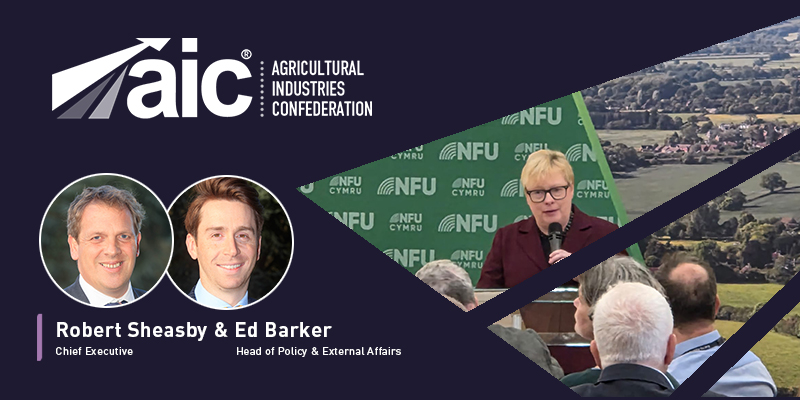
Why does party conference season matter to the agricultural supply industry? The Agricultural Industries Confederation's (AIC) Chief Executive Robert Sheasby and Head of Policy and External Affairs Ed Barker share what they heard from across the political spectrum and why being in the room helps ensure AIC Members’ priorities are heard by policymakers and decision-makers.
Party conference season provides an important opportunity to hear first-hand where political thinking is heading, but also to make sure agriculture, food security and the agricultural supply chain are part of those conversations.
Following conferences and political events across the UK, AIC Chief Executive Robert Sheasby and Head of Policy and External Affairs Ed Barker joined Wendy Ford, AIC Communications Manager on The AIC Podcast to reflect on what stood out, what matters for Members and what happens next.
Different parties, different conversations
One thing that came through clearly was just how different each conference was.
Ed described Reform UK’s conference as very member-focused, with much of the activity taking place in the main hall, while the Conservative Party conference had greater depth of discussion in fringe events and policy discussions.
At the Liberal Democrat conference in Brighton, food security was firmly on the agenda, with the party debating a dedicated food security paper. Robert and the AIC team were able to discuss this with Alistair Carmichael and members of the Liberal Democrat team.
Labour’s conference in Liverpool was a much bigger event, and Robert highlighted the importance of using the fringe meeting network to identify opportunities for meaningful conversations with ministers.
As he explained: “It’s going through the fringe meeting network and sorting out where you think those ministers are going to be and ensuring we’re able to have good, good quality conversations about the issues AIC Members are talking about.”
Those issues included energy, food security and business cash flow.
Why the fringe matters
For Members, the importance of party conference season goes beyond speeches from the main stage.
Fringe events provide opportunities for direct conversations with ministers, shadow ministers and MPs sitting on parliamentary select committees.
As Ed put it, conferences are “quite a helpful place to get straight to them”, while Robert noted that when AIC approaches those conversations professionally, “you get listened to” and can have discussions that can otherwise be challenging to secure in Westminster.
That engagement extended beyond Westminster politics.
At the Scottish Natioal Party (SNP) business day in Edinburgh, AIC held one-to-one conversations with First Minister John Swinney, the Deputy First Minister and farming minister Jim Fairlie, discussing the challenges Members are raising and the policy priorities AIC wants policymakers to consider.
Growth, costs and the pressures facing businesses
Across the conferences, one recurring theme was the economic environment facing businesses.
Robert highlighted messages at Labour conference around investment and “growth in every postcode”, arguing that this creates an opportunity for the agricultural supply industry to demonstrate the part it can play.
“If you want growth in every postcode, we’ve got the solutions to the answer to that problem, but you’ve got to change some of the policy around how different works. Create a space where we can talk positively about growth, create the right economic environment for growth.”
Business growth was also part of the conversation at the Liberal Democrat conference, while Robert noted that partnership with business was discussed particularly strongly at the SNP event.
Alongside the focus on growth came recognition of costs. Ed described a strong focus on the cost of living, energy, trade barriers and wider business costs across the conferences he attended.
Food security remains central
Food security was another theme running through the conference season.
From the Liberal Democrats’ food security paper to AIC’s wider conversations with political parties, there were opportunities to reinforce the importance of agriculture and the supply chain as part of the UK’s national infrastructure.
As Robert said: “Interesting times, but times in which we can land messages and ensure an understanding of the critical importance of national infrastructure and food security.”
For AIC, that means continuing to explain the role Member businesses play in supporting farmers and growers and ensuring the supply of essential inputs and raw materials.
The UK-EU relationship comes back into focus
Another significant theme was the future UK-EU relationship.
Ed highlighted the different political perspectives around the relationship, but also the growing focus on trade barriers, the cost of living, barriers to growth and business costs.
For agriculture specifically, crop protection and sanitary and phytosanitary (SPS) arrangements were among the issues raised. Ed also highlighted the practical question of how the UK Government influences European discussions if future arrangements involve greater alignment with the EU.
The discussion goes beyond SPS issues, with emissions trading schemes and other potential areas of alignment also part of the picture.
For agricultural supply businesses, the important question is what any future agreements mean in practice.
What happens next?
The wider economic backdrop remains difficult.
Robert summed up the challenge facing Members: “That inflationary pressure just seems relentless at the moment from the wider geopolitical instability. And our members are really caught right in the middle of this.”
AIC Members are working to find the best market opportunities for farmers and growers while ensuring the supply of raw materials, including fertilisers and animal feed products.
That makes clear and workable policy particularly important.
Being in the room
Perhaps the clearest takeaway from conference season came in the final quick-fire question of the podcast.
For Ed, a more fragmented political landscape brings additional opportunities: “Multiple parties now means that we have extra opportunities to land key messages about agriculture, food security, and the supply chain.”
Robert brought the discussion back to the reason AIC attends these events in the first place: “It’s by being in the room, we can ensure that every member’s voice is heard by those policy makers, decision makers who are going to impact every single member business. And the only way that happens is by us being in the room, at the table, having those conversations.”
And ultimately, that is the “so what?” from party conference season for AIC Members. The conferences provide an opportunity not simply to observe political debate, but to make sure the practical realities facing agricultural supply businesses are part of it.
Listen to the full discussion: Party Conference Season 2026: What It Means for UK Agriculture and the Agri Supply Chain
Authors

Ed Barker