

2026 Elections Results in Scotland and Wales
The 2026 Scottish Parliament and Welsh Senedd elections have resulted in no party securing an outright majority in either nation, meaning both administrations will be required to work with other parties to take policies forward
Scotland
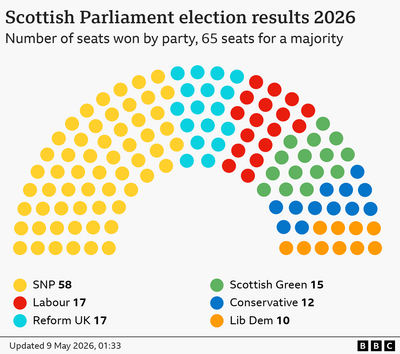
In this year’s election, the Scottish National Party (SNP), led by John Swinney, won the largest number of seats (58), marking its fifth consecutive victory; however, it fell short of the 65 seats required for an outright majority, resulting in a hung parliament.
This outcome was anticipated in the pre-election polling, with the key question being whether the SNP could secure a full majority. As it did not, the party will need to work with other parties to ensure policies can be taken forward. This may result in a coalition with the Scottish Greens.
Labour and Reform UK tied for second place with 17 seats each, marking a significant breakthrough for Reform UK. The Scottish Greens won 15 seats, the Conservatives dropped sharply to 12 seats, and the Liberal Democrats increased their representation to 10 seats. Voter turnout was relatively low (around 53%).
Given the continuation of SNP leadership, no considerable changes in wider agricultural policy are expected. However, notable manifesto commitments include support for active farming and food production, including direct payments to provide certainty for the industry and continued commitment to the four-tier support framework. A new Rural Renewal Bill is proposed to improve planning processes and permitted development, alongside a review of industry levy bodies.
One notable commitment is the proposal to establish statutory price ceilings on a basket of essential food items at large supermarkets to provide relief to families struggling with grocery bills. This may present challenges in practice and could lead to unintended consequences across retailers, wholesalers and the wider supply chain.
Wales
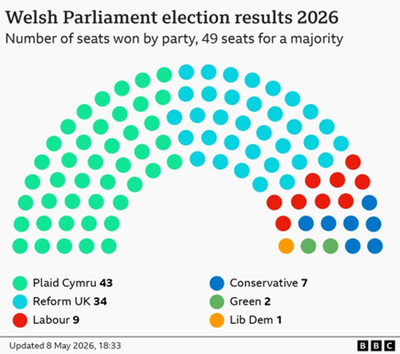
In this year’s Welsh election, Plaid Cymru secured the largest share of seats (43), becoming the largest party in Wales for the first time and ending over a century of Labour dominance.
Welsh Labour experienced a significant defeat, winning just 9 seats. Reform UK came second with 34 seats, representing a substantial breakthrough. The Conservatives won 7 seats, the Greens entered the Senedd for the first time with 2 seats, and the Liberal Democrats secured 1 seat. Turnout was approximately 52%, a record for a Senedd election.
As no party achieved the 49 seats required for a majority, Plaid Cymru will need to form either a coalition or a minority government. This outcome aligns with pre-election expectations.
As a new party in power, it remains to be seen how Plaid Cymru will establish itself in government; however, some degree of policy continuity is expected, particularly in agriculture.
Key manifesto commitments include establishing a multi-year funding cycle for the Sustainable Farming Scheme (SFS) to give farmers long-term stability and certainty, commissioning an independent review of the bureaucratic burden on family farms, and implementing a new science-led, outcomes-based approach to managing nitrate vulnerability.
Further commitments include maintaining robust biosecurity measures, implementing a new approach to managing bovine tuberculosis (bTB), protecting high-quality agricultural land, and extending permitted development rights to support small-scale renewables.
What this means
Across both nations, the results mean minority or coalition governments are likely, with parties needing to work together to secure support for legislation.
There are also significant shifts in political representation, particularly in Wales, where many new Members of the Senedd have been elected, and Reform UK has established a substantial parliamentary presence.
As new administrations form, engagement with policymakers and stakeholders will begin as soon as possible, alongside ongoing activity and events planned for later in the year.